






Every person has a memory of the building at 2141 Salta Street. Through those memories, the image of the building is composed and decomposed, fragmentarily. The image includes the people who lived in it and on its block, the tree, the sidewalk, the neighboring houses: an entire setting for life and its relationships that was wounded and lost, and although part of it has survived, it is not the same block: what persists does so as if blurred by absence, disrupted by loss.
If it is true that, as Marcel Proust held, every hour lived becomes embodied and hides behind its passing within some material object, the explosion cut short the possibility for countless moments to attain that survival. For this reason, the proposal restores that possibility by rescuing from oblivion the building that once existed and, based on its original plans, reconstructing its shell, its imprint. A wall of white, abstract concrete, a great pale sculpture, is now the refuge for so many wandering memories. It is our way, as a society, of honoring the dignity of the everyday life of those who were lost when they lost their home.
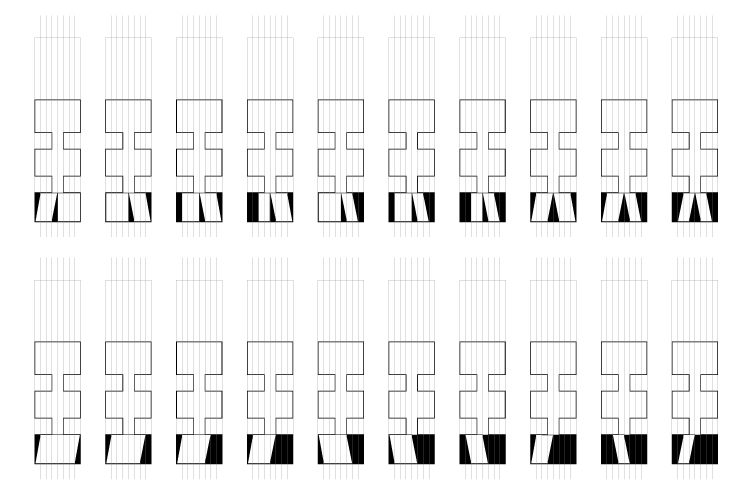
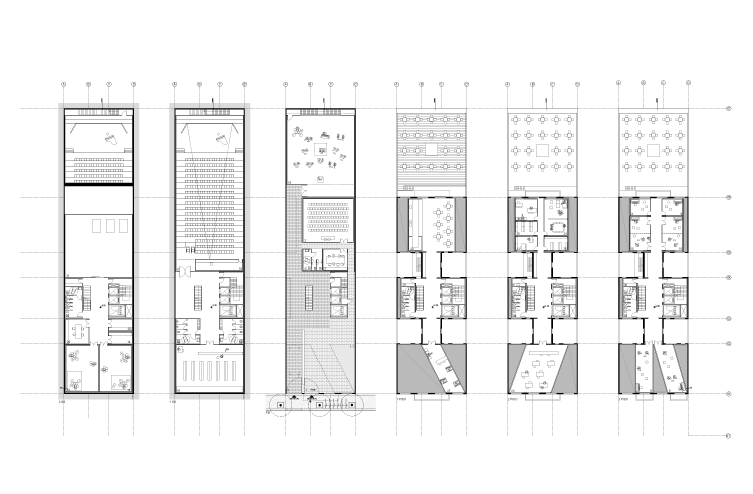
The project begins by reconstructing the principal features of the building that existed, just as they were: the precise silhouette of its volume, the rooftop terrace and water tanks, the rhythmic arrangement of window openings, the rows of balconies, the recessed entrance. The new building is almost a pentimento of the one that was, that which has settled in the sieve of memory. It is a scheme, a succession of solids and voids, a curtain of concrete with its pores for light, air, and the communication between outside and inside. It is a shelter that, as such, offers support and protection to everyone’s memories, a shell that safeguards the traces of voices, faces, things: countless snapshots caught in different memories.
With its original imprint restored, the tree, the sidewalk, the neighboring houses, the houses across the street, once again re-establish the relationships that bound them within the system of the block, and the dialogue between them is reborn.
We enter it in a way similar to how we would have before, but instead of the lost interior, we find ourselves in the middle of an empty nave. Inside, the alternation of light coming from the street and the opacity of the walls form the fabric of a vast, cathedral-like space that rises upward. The immense void, bathed in light entering through the original windows, is a space at once intimate and monumental. Familiar, and yet never seen before.
But the void is not total: a series of wooden volumes are arranged in a cascade, inhabiting the interior, bathed in the watery flow of light. Carefully and rhythmically, the great void gradually fills with wooden boxes that latch onto the concrete walls, using the openings of the original windows to bring them light and air. They are music boxes, cases that manage at once to isolate themselves from the surrounding soundscape and to acoustically condition their interior for their uses.
Through the architectural and aesthetic experience proposed by the ensemble, the work aims to remain open to all subjective interpretations of this piece of our city’s history. Everything is memorial, everything is school, everything is city. Everything is past and everything is future, united by music, which is pure present.